Ritualism Definitions and Examples in Sociology
A 1,009-word essay, formatted in APA 7 (about 4 double-spaced pages).
- Type
- Essay
- Length
- 1,009 words, 4 pages
- Style
- APA 7
Contents (10 sections)
- In sociology, ritualism involves completing socially accepted activities even though they do not align with your values or beliefs but go along with the activity’s goals. It maintains that an individual should reject the idea of traditional cultural goals but still maintain the ways to achieve them.(Ritualism Definitions and Examples in Sociology Comprehensive Essay)
- Ritualism Definitions and Examples in Sociology Comprehensive Essay
- Ritualism Definitions
- Structural Strain Theory
- Behavioral Ritualism
- Behavioral Ritualism in Society
- Bureaucratic Ritualism
- Political Ritualism
- Educational Ritualism
- Religious Ritualism
EssayAPA 7
Ritualism Definitions and Examples in Sociology
Ritualism Definitions and Examples in Sociology
In sociology, ritualism involves completing socially accepted activities even though they do not align with your values or beliefs but go along with the activity’s goals. It maintains that an individual should reject the idea of traditional cultural goals but still maintain the ways to achieve them.(Ritualism Definitions and Examples in Sociology Comprehensive Essay)
For example, politics is a ritualism where individuals, regardless of whether they have a candidate of choice, still vote out of ritualism. In this case, the individual participates because it is a government-established system to obtain new leaders.
Ritualism Definitions and Examples in Sociology Comprehensive Essay
Ritualism Definitions
Ritualism is a concept that was developed by American sociologists Robert K Merton in his structural strain theory. He explained that it is the common practice where individuals go through daily life activities even though they do not accept the values and goals that align with those practices.
Structural Strain Theory
Ideally, the strain theory argues that individuals experience a certain level of tension when they do not achieve culturally valued goals or are not being given the appropriate resources for their achievement. For this reason, people follow various activities to accomplish these socially accepted goals.
In contrast, others change their behaviors which become different from the cultural norm. In this case, ritualism is the concept in which a person does not seek to achieve the goal of society but actively participates in achieving this goal. Ritualism often occurs in cultures where the community members maintain the same behavior that will help achieve the goals to conform with the society.
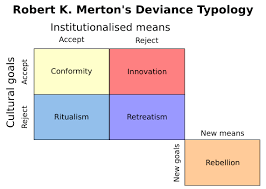
Conformity is the acceptance of goals and the means to reach them. In this case, society creates general goals achievable by specific means. Therefore, individuals of the same society tend to perform their behaviors in a particular way to meet these goals, such as marriage.
Based on maintenance theory, ritualism is a response to structural strain theory, where some people accept these conditions and go along with them. On the contrary, others devise ways of acting and thinking differently to deviate from the cultural norms.
Behavioral Ritualism
The strain theory also accounts for conformity which is the continued approval of means one is supposed to achieve. In this regard, ritualism involves accepting the goals but finding new ways of achieving these goals rather than following the standards provided by society.
On the other hand, retreatism is the acceptance of both goals and means, while rebellion involves rejecting both the goals and the standards and creating new goals and the respective means to pursue them. Therefore ritualism is deviance where a person rejects the normative goals of the society but still agrees to the practices involved as the person continues to act in a way that is in line with achieving those goals.
Behavioral Ritualism in Society
For example, an individual may not embrace the goal of the societal class and stay ahead of the others by earning as much money as possible or growing career-wise. However, they may continue looking for extra jobs or working overtime, which is aligned with getting ahead of society.
In this instance, an individual may conform and follow this behavior to get wealth and belong to a social class, which is the definition of success in such a community. On the contrary, other individuals who do not value economic success and define success in other ways are more likely to reject the goal of working hard to climb the economic ladder. However, even after rejection, most of them will still spend their time at work away from their families and friends in attempts to gain status or increase their salary in their professions, although they do not support the goal set by society.
Although ritualism stems from being discontent with the values and goals of society, it plays a significant role in maintaining the status quo by keeping everyday practices and behaviors in place. As a result, it helps maintain order and avoid a rebellious society.
Apart from the ritualism that describes behavior among individuals, socialists have identified other forms of ritualism, as discussed below.

Bureaucratic Ritualism
Bureaucratic ritualism has a hierarchical structure with a system of rules. However, its rigidity may be limiting, especially for today’s organizations. This ritualism means that the rules are being followed consistently in the system practice to the point that an organization can no longer meet its goals.
Specifically, these organizations have demanding and too stringent rules to the point that they are counterintuitive to the organizational goals. The military government and police units are examples of bureaucratic systems which use ritualism to reinforce their authority.
This system allows them to rationalize the activities and strengthen the sense of belonging among its members. For instance, members of these organizations reinforce ritualism by displaying their badges and flags, introducing regular procedures in which the members should participate, and using badges to indicate an individual’s rank.
Political Ritualism
Political ritualism involves a routine to express attitudes or feelings in public places. It is a form of political behavior mainly associated with prominent public events, statesmen, and politicians. In this regard, political ritualism is a means of self-promotion where politicians act in a specific way to gain public support and popularity.
Educational Ritualism
Schools and other educational institutions use ritualism to reinforce their learning objectives. In this case, the school expects students to wear special outfits and recite facts that align with the school’s goals.
For example, in the flag-raising ceremony, the students stand and sing the national anthem. Additionally, they recite pledges and odds, which indicates ritualism.
Religious Ritualism
Ideally, religion is associated with ritualism across different cultures. For example, religions perform sacred rituals to reinforce their beliefs in their members, such as wearing special outfits, reading scriptures, giving authority, chanting repetitive phrases, praying, or listening to sermons. Other cultures may involve dances and purification ceremonies such as voodoo which they believe to drive evil spirits away.
This paper is a sample from a completed student assignment, published to help you understand structure, argument and APA formatting. Use it for inspiration and reference only, and cite it if you quote it.
Get this paper as a Word file
ritualism-definitions-and-examples-in-sociology-.docx, with an APA title page and reference list, ready to edit in Word or Google Docs.
Need a custom paper on Ritualism Definitions and Examples in Sociology?
Get an original, plagiarism-free paper written to your rubric by a nursing expert.
Cite This Paper
Pick your style, then copy. Italics are kept when you paste into Word or Google Docs.
Premium Academic Affiliates. (2023, January 15). Ritualism Definitions and Examples in Sociology [Essay example]. https://premiumacademicaffiliates.com/ritualism-definitions-and-examples-in-sociology-comprehensive-essay/
(Premium Academic Affiliates, 2023)
Premium Academic Affiliates. (2023, January 15). Ritualism Definitions and Examples in Sociology [Essay example]. Retrieved from https://premiumacademicaffiliates.com/ritualism-definitions-and-examples-in-sociology-comprehensive-essay/
(Premium Academic Affiliates, 2023)
“Ritualism Definitions and Examples in Sociology.” Premium Academic Affiliates, 15 Jan. 2023, premiumacademicaffiliates.com/ritualism-definitions-and-examples-in-sociology-comprehensive-essay.
(“Ritualism Definitions and Examples”)
Premium Academic Affiliates (2023) Ritualism Definitions and Examples in Sociology. Available at: https://premiumacademicaffiliates.com/ritualism-definitions-and-examples-in-sociology-comprehensive-essay/ (Accessed: 15 October 2026).
(Premium Academic Affiliates, 2023)
Premium Academic Affiliates. 2023. “Ritualism Definitions and Examples in Sociology.” January 15, 2023. https://premiumacademicaffiliates.com/ritualism-definitions-and-examples-in-sociology-comprehensive-essay/.
(Premium Academic Affiliates 2023)
Premium Academic Affiliates. “Ritualism Definitions and Examples in Sociology.” January 15, 2023. https://premiumacademicaffiliates.com/ritualism-definitions-and-examples-in-sociology-comprehensive-essay/.
1. Premium Academic Affiliates, “Ritualism Definitions and Examples in Sociology,” January 15, 2023, https://premiumacademicaffiliates.com/ritualism-definitions-and-examples-in-sociology-comprehensive-essay/.
Premium Academic Affiliates. Ritualism Definitions and Examples in Sociology [Internet]. 2023 Jan 15 [cited 2026 Oct 15]. Available from: https://premiumacademicaffiliates.com/ritualism-definitions-and-examples-in-sociology-comprehensive-essay/
[1] or (1)
Premium Academic Affiliates. Ritualism Definitions and Examples in Sociology. Published January 15, 2023. Accessed October 15, 2026. https://premiumacademicaffiliates.com/ritualism-definitions-and-examples-in-sociology-comprehensive-essay/
1
Published . Updated .